Paris’ Celebrity Cemetery
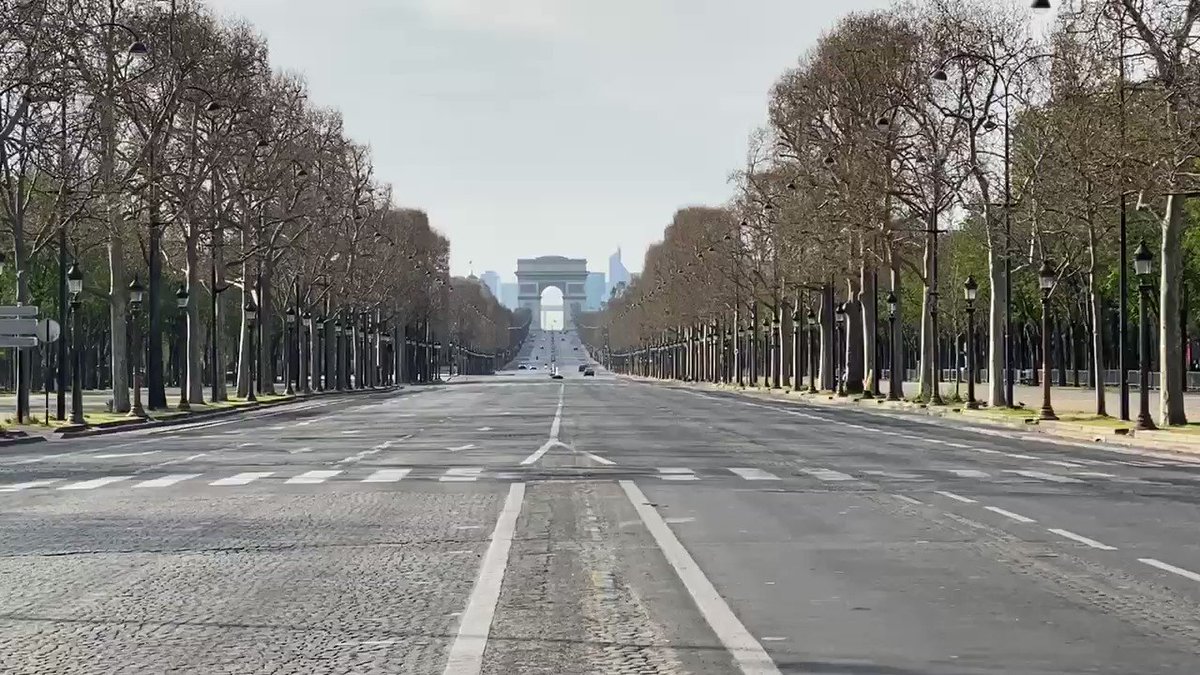
PARIS, APRIL 23, 2020 — The City of Light is locked down. The Champs-Élysées is empty, deserted. Not a soul stands gaping at the Eiffel Tower. With COVID-19 raging, dozens of bodies are taken to city cemeteries each day.
“Death,” a French saying notes, “is a tyrant who spares no one.” But then deep inside Paris’ most celebrated cemetery, life emerges.
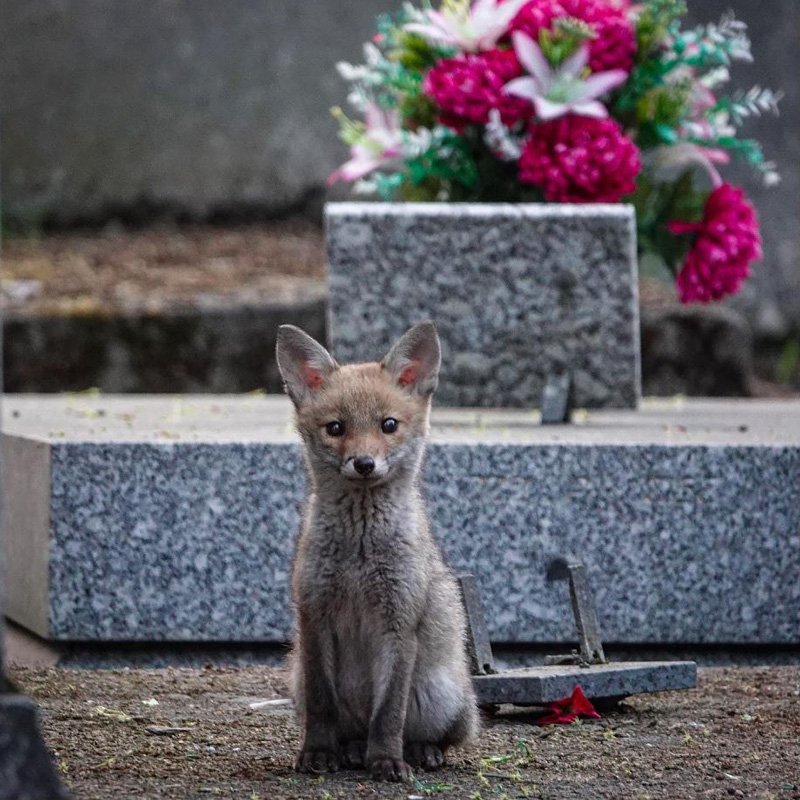
Walking that spring afternoon through Père-Lachaise, curator Benoit Gallon “crossed paths with a fox cub. It was a miraculous discovery. The moment I posted the photograph to social media, the press went into a frenzy. It didn’t take long before the snapshot wound up on the front page of Le Parisien.”
Since the mid-1800s, when it became the “in” place to be buried, Père-Lachaise has been surprising the world. More than three million people a year visit this celebrity graveyard. Most come to find a famous name carved on a tombstone.
Oscar Wilde. Marcel Marceau. Gertrude Stein. . .
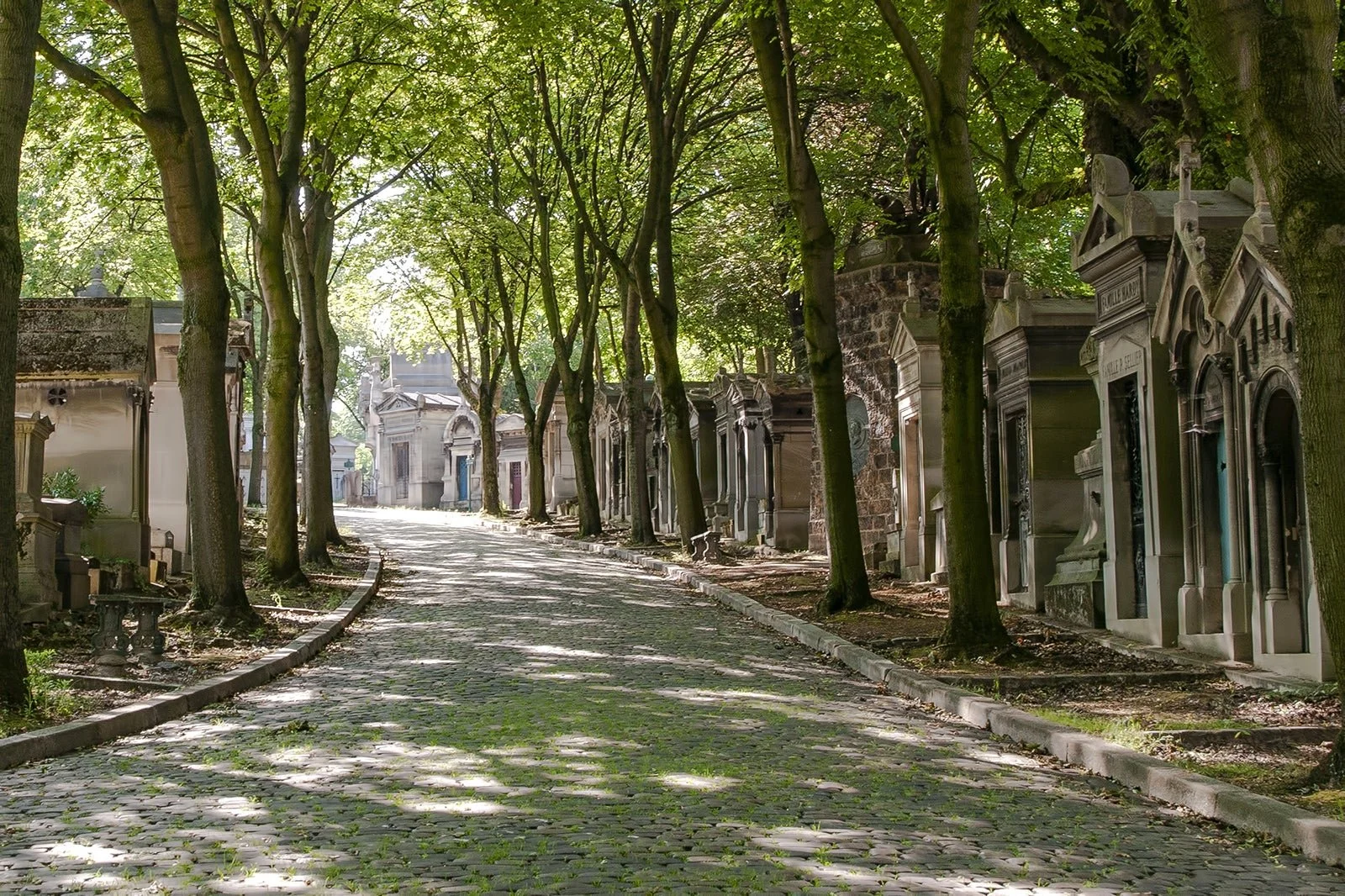
But visitors are soon swept into a labyrinth of shrouded paths that twist life, death, and nature into the folds of memory and time.
“Père-Lachaise is an ever-changing, ever-evolving work of art,” said one historian. “Whether by conscious design or due to fiscal constraints, nature and time have taken the upper hand there among its monuments and mausoleums in a wild, marvelously unkempt way.”
Isadora Duncan. Sarah Bernhardt. Richard Wright. . .
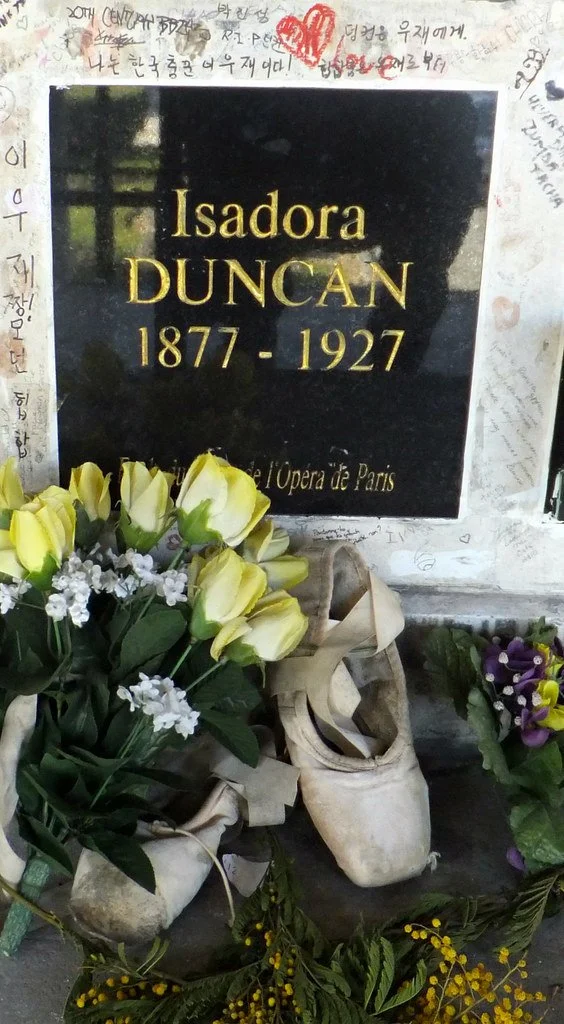
To be buried in Père-Lachaise, one only has to live or die in Paris, then wait in line. That explains the cross-cultural collection of famous graves. While many names are known only to students of French history, Père-Lachaise’s permanent residents include a German film director, an Iranian military commander, a Romanian actress, assorted Italian composers, a Russian ballerina, a Kurdish politician, novelists from Iran, Armenia, and Guatemala, various Russian aristocrats, and a certain American rock star. (More about him later.)
Marcel Proust. Edith Piaf. Frederic Chopin. . .
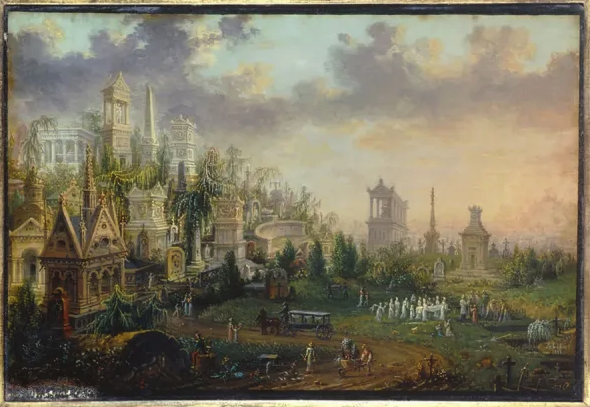
The oldest joke about cemeteries is that “people are dying to get in there.” But when Père-Lachaise opened in 1804, it nearly died of neglect. A few days after Napoleon was crowned as Emperor, he shocked France by removing the exclusive burial rights of the Catholic church. “Every citizen has the right to be buried regardless of race or religion,” the Emperor proclaimed. Secular cemeteries soon opened on the far corners of Paris. The least popular was Père-Lachaise.
Far removed from the heart of Paris, cold, hilly, gloomy, Père-Lachaise had just a few dozen burials each year. Then in 1817, city officials moved the remains of French fabulist Jean De la Fontaine and the playwright Moliere to Père-Lachaise. Burials picked up slightly but it took two lovers to plant the cemetery in the heart of Parisians.
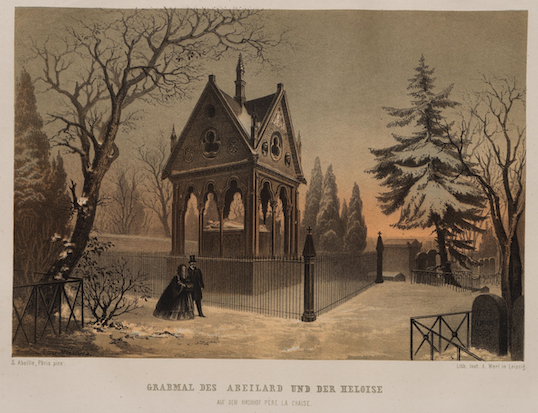
All of France knew of the star-crossed lovers Heloise and Abelard. She was a nun, he a priest and her teacher. Their forbidden love led to exile and legend. And when Heloise and Abelard, buried across town in the 12th century, were moved to Père-Lachaise, visitors flocked to their adjacent graves, bringing flowers.
By 1830, thousands a year were buried at Père-Lachaise. And because Paris, as the critic Walter Benjamin noted, was “the capital of the 19th century,” time and fate continued calling to Europe’s artists, writers, and composers, offering a plot at Père-Lachaise.
Camille Pisarro. Colette. Eugene Delacroix. . .
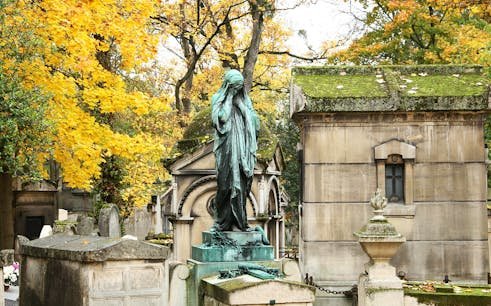
A census of this city of the dead counts 70,000 graves plus the bones or ashes of a million more. The pace of burials has slowed to a few per day, but crowds keep coming. Even with a map, it’s easy — and fun — to get lost in Père-Lachaise. Cobblestone streets wind past stone crypts of unknown Jeans and Maries. Check the map again. So where is Jean-luc Godard? On past more Henris and Sylvies, you stroll past lovely statues and looming angels. With luck, you might stumble upon the most visited grave of all.
When The Doors’ Jim Morrison died in Paris in 1971, the caretakers of Père-Lachaise had little idea what they were getting into. Because once Morrison’s tomb was installed in the cemetery’s Division Six, dozens of “mourners” came to drink, smoke, and party with the man who sang “This is the end. My only friend. . .”
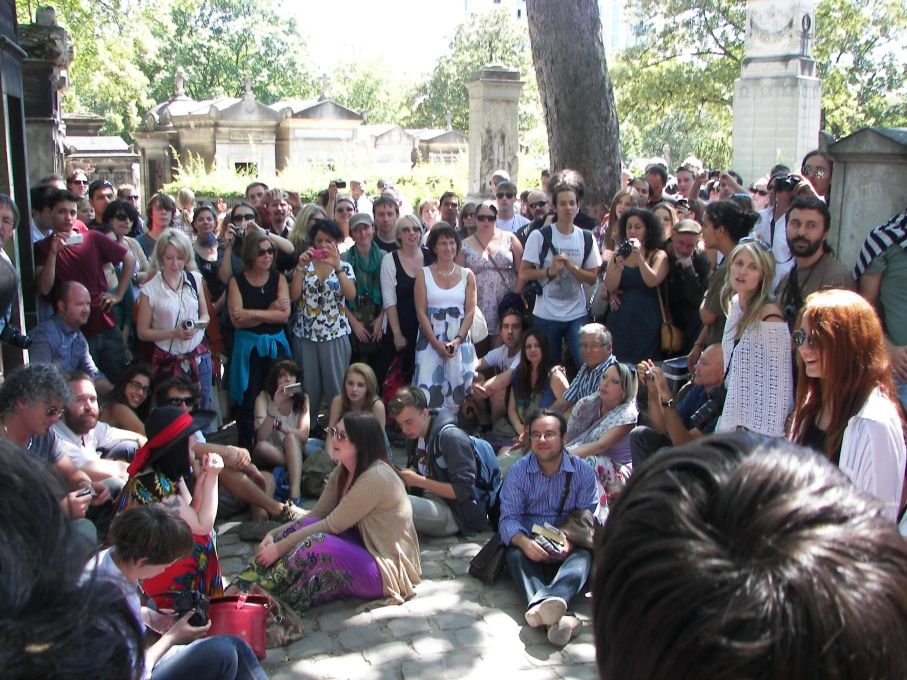
There was talk of removing Morrison but his parents soon paid for lifetime internment. Crowds continued, upsetting the solemnity. These days, except on July 3, the anniversary of Morrison’s death, the party has died down, yet Morrison’s gravesite is perpetually strewn with empty bottles. He was not, however, the first corpse to disturb Pere LaChaise.
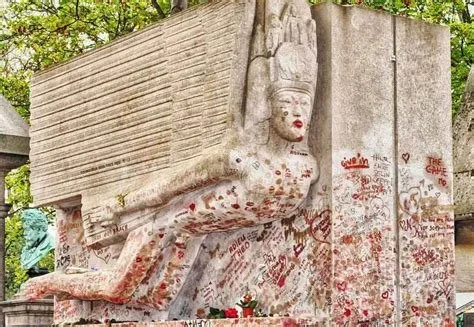
A large Art Deco angel marks the grave of Oscar Wilde. From its installation in 1914, mourners donned red lipstick and kissed the stone, leaving stains. Wilde’s tomb is now encased in glass.
Time has blessed Pere LaChaise, turning an old graveyard into a fantastic urban jungle. But only recently was Life allowed to bless this place. Out of respect for the dead, nothing living was supposed to flourish. Heavy doses of pesticides once kept live flora and fauna at bay. “The smallest dandelion had to be eliminated,” a gardener said. “It was the ‘golf green’ mentality.’”

Then in 2011, to combat global warming, Paris began reclaiming its greenery. Pesticides were phased out in parks and cemeteries. Feral cats, which once haunted Père-Lachaise, were sterilized or removed, allowing 100 species of birds to flourish. Foxes, owls, and other animals took up residence. “Nature is taking back its rights,” said curator Benoit Gallot, who lives with his family in the middle of Père-Lachaise.
Though death remains “a tyrant,” Paris’ celebrity cemetery lives on, a delightful blend of mortality and memory. Lovers still put flowers on the graves of Heloise and Abelard. Women seeking fertility still come to the grave of journalist Victor Noir, whose statue sports “a peculiar prominence under his pants,” rubbed gold by visitors. And someone is always leaving cakes of madeleine and cups of tea on the grave of Marcel Proust. In remembrance of things past.
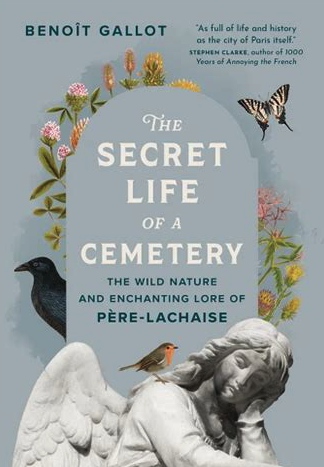
As nature blooms, Père-Lachaise now offers hope amidst its shrouded sorrow. “I love cemeteries,” Benoit Gallot wrote in The Secret Life of a Cemetery, “because I am convinced that, far from the sad, bleak places we imagine them to be, most are soothing spaces full of unexpected riches.”